Showing posts with label astronomy. Show all posts

Wednesday, June 09, 2010

To Mandy Smith

The following tribute to Mandy has appeared on Spring Haiku 2010.

To Mandy Smith,
an admirable creator and person,
and a great friend of the Romanian Society for Meteors and Astronomy (SARM)

Text: Andrei Dorian Gheorghe (cultural counsellor of SARM)
Photo: Valentin Grigore (President of SARM)

Thursday, November 05, 2009

More for Mandy


Mandy has just forwarded me this email and asked me publish an edited version along with these two images:
Dear Mandy,

You are an extraordinary woman and I cannot express how much I love you as a friend. I am working to finish five new pages for the Astropetry 2009 project, and one of them will be Galilean Poetry (including your Galileo Wordle). I send you in advance the trophy of the event (with your name written on it). My only power is to think of you with love. Be strong and be blessed.
With all my best wishes,

Andrei Dorian Gheorghe


Mandy is touched by everyone's affection but will not be replying personally to anyone. I am honoured that she has allowed me to keep her blog online.

Tuesday, July 28, 2009

Earth to Outer Space in 12 minutes


Got 12 minutes to spare? Want to get away from it all?
Then take a trip from Earth to Outer Space.

Using footage from the Mars Odyssey Launch and images from the Hubble Telescope, NASA's Mars Pathfinder and elsewhere this Macromedia flash presentation makes fascinating viewing.

The Space Wander website has lots of astronomical links to check out.

Tuesday, May 26, 2009

Astronomical Paris 2009


Astronomical Paris is a record by photographer Valentin Grigore and writer Andrei Dorian Gheorghe of their visit in January 2009 to the United Nations Educational, Scientific and Cultural Organization, and the International Astronomical Union for the International Year of Astronomy 2009 under the Sign of Galileo.

Heavenly Bodies Over Paris-Meudon


The Paris Royal Observatory


Of the many photographs, all © 2009, Valentin Grigore, these three are my favourites.

Sunday, December 21, 2008

Favourite Constellations


The latest offering from SARM's Astropoetry Master Club and Friends is Favourite Consetellations coordinated by Andrei Dorian Gheorghe and designed by Florin Stancu after an idea by Mihai Petrache (initially debated on the SARM mailing list by Romanian sky lovers from all over the world)

My contribution was this wordle.

The anthology consists of photographs and poetry; David R Keedy writes about the celestial zoo; Valentin Grigore photographs Venus, Moon, Jupiter, November 2008; Alexandru Tudorica presents a photo-collage of Perseids 2008; Andrei Dorian Gheorghe provides
Sagittarius -
centaur tattooed with
Messier deep sky objects
Deborah P. Kolodji wonders what it would be like to ride Pegasus and Dominic Diamant answers her; Bruce Boston pens an astro-fantasy; Adrian Bruno Sonka photographs NGC4565 Spiral Galaxy in Coma Berenices; Alastair McBeath describes watching Orion; Ovidiu Vaduvescu observes the Southern Cross in Hawaii; the chorus of an astrofolk song by Dan Mitrut goes
Why are you so amazed?
This world is a mirror with an inverted image
And we don’t know to separate
The mystery from the farce.
Many other anthologies of photographs and poetry can be found on Cosmopoetry.

Wednesday, September 10, 2008

Intercontinental Astro-ecologic Verse Tournament


Partial Solar Eclipse, 2008-08-01
Photo © Alex(andru) Conu (Romania)

The latest production from SARM is an Intercontinental Astro-ecologic Verse Tournament dedicated to 100 years since Victor Anestin founded the first Romanian astronomical society (presided by Admiral Vasile Urseanu) and 90 years since he started to eternity.

The project also celebrates 15 years of existence of the Romanian Society for Meteors and Astronomy-SARM (the second national astronomical society in Romania’s history), organized by Valentin Grigore (Founder of SARM) and Andrei Dorian Gheorghe (Project Coordinator).
At the G8 conference where are the sun and the moon to sit?

Mandy Smith


Total Solar Eclipse over Novosibirsk, Siberia, Russia, Asia, 2008-08-01
Photo © Yasuhiro Tonomura (Japan, Oriental Astronomical Society)

The number and variety of contributions both poetic and photographic to this tournament is truly breathtaking.

Monday, May 12, 2008

WORLD ASTROTIPURITURA CHAMPIONSHIP


In honour of the late Costica Gheorghe, SARM (Romanian Society for Meteors and Astronomy) organised the first World Astrotipuritura Championship.

I was invited to make a contribution and submitted:

Red sky at night the shepherd
Hoisted by his own petard

Cioban la cer insangerat
De-a sa petarda inaltat


The Romanian translation is by Andrei Dorian Gheorghe.

All the contributors were declared champions and you can view all the poems, together with information about astrotipuritura and many excellent photographs on the World Astrotipuritura Championship website.

Tuesday, April 29, 2008

Costica Gheorghe 1927-2007


In December I published a tribute to Costica Gheorghe by his son, Andrei.

Now Andrei has collected other reminiscences and photos and created an excellent memorial to his father, Costica the Astropoetic Dad.

It is an excellent compilation of photographs and poems and memories.

Thursday, February 21, 2008

Lunar Eclipse 2008

It was unfortunately too cloudy to see last night's total lunar eclipse.

It was a particular shame as the previous nights had been exceptionally clear.

This is one video I found of the event.


and here is another


and a third

Monday, December 31, 2007

Gravitas

ever since
an apple fell
on Newton's head
the world has been going
slowly down hill

This haiga using a photograph by Kris Foo is our contribution to Newton and the Striking Apple. This consists of astropoetry, astro-photo-poetry, astrohaiku and images by SARM and Friends, coordinated by Andrei Dorian Gheorghe.

Tuesday, December 25, 2007

COSTICA GHEORGHE (1927-2007)

This tribute to Costica Gheorge by his son Andrei Dorian Gheorghe was published recently in METEOR CONTEMPORARY POETRY PROJECT NEWSLETTER (10).

The issue is dedicated to Costica Gheorghe (1927-2007, participant at the International Meteor Conference 2000 in Pucioasa, Romania), whose anonymous efforts helped very much the Meteor Contemporary Poetry Project and the Astropoetry Shows of the International Meteor Conference.

TO COSTICA GHEORGHE (1927-2007),
A MAJOR SUPPORTER OF THE METEOR CONTEMPORARY POETRY PROJECT


Father,
do you remember the Perseid nights
when we watched like two children
the meteors dance among the joyous stars?

Father,
do you remember how enthusiastically
you and my mother vibrated and helped me
in preparing astro and meteor exhibitions,
astropoetry galas
and international astroshows?

Maybe some day we shall be together again,
free to admire all the meteor showers
in the Universe,
free to prepare other exhibitions,
galas and astroshows
for other worlds,
better than this tragic Earth.

You, my mother and me,
we ourselves three falling stars.

Andrei Dorian Gheorghe (Romania)

Other meteor poem anthologies can be found at: Cosmopoetry - SARM and Friends

My condolences and sympathy to Andrei and his family.

Monday, December 04, 2006

Hubble Heritage Information Center


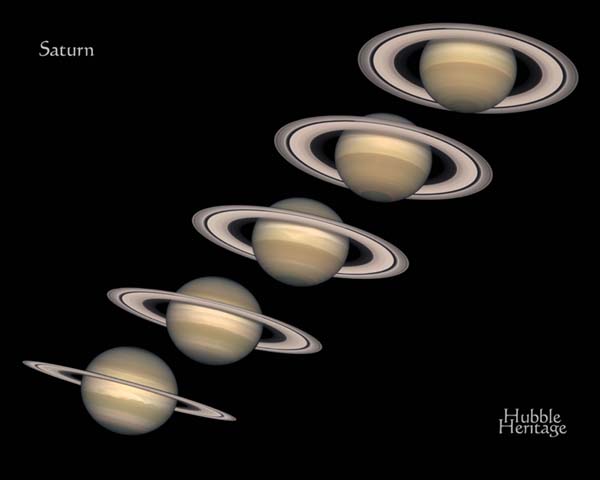
This image of Saturn (credit: "NASA, ESA, and The Hubble Heritage Team (STScI/AURA).")is just one of a galaxy of images available at the Hubble Heritage Information Center

It is well worth a visit.

Sunday, November 19, 2006

Passports for a Heavenly Expedition


I wrote earlier about 2006 Solar eclipse.

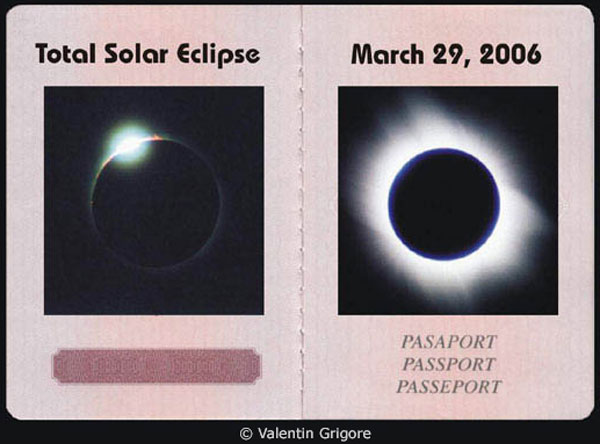
Passports for a Heavenly Expedition is an account in words and pictures of the expedition by members and friends of the Romanian Society for Meteors and Astronomy who travelled to Antalya in Turkey to view the 2006 Total Eclipse.

The image above is copyright Valentin Grigore and is just one the many delightful pictures found on the fifteen pages of this website.

Thursday, September 07, 2006

Planet Pluto

On January 23rd, 1930 Clyde Tombaugh, making a careful survey of the sky from the Lowell Observatory in Arizona, spotted a dim speck moving among the stars. It was quickly hailed as the 9th planet from the Sun.

Venetia Phair (née Burney), then an 11-yr old schoolgirl in Oxfordshire suggested the title Pluto for the newly discovered ninth planet.

Named after the Roman god of the Underworld [not the Disney dog who was named after the planet, rather than the other way round as some have mistakenly thought], on 1st May, 1930, the name Pluto was formally adopted.

As Dr. Tony Phillips and Amelia Phillips relate in Much Ado about Pluto, Pluto was a misfit from the beginning, but its planethood was never seriously questioned until 1992.

Pluto's neighbourhood is cluttered with icy bodies about the size of asteroids. They orbit the sun in a busy belt beyond the orbit of Neptune. Gerard Kuiper in 1951 had predicted such a belt to explain where certain comets came from, and today it is called The Kuiper Belt. Its discovery (with Pluto inside it) troubled some astronomers. "Is Pluto a planet?" they asked. "Or is it just another Kuiper Belt Object (KBO)?"

Then on 29th July 2005 it was reported that a 10th planet had been discovered.

The planet was found by Dr. Mike Brown and colleagues using the Samuel Oschin Telescope at Palomar Observatory near San Diego. Definitely bigger than Pluto, the new planet, officially known as 2003 UB313 and unofficially called Xena was placed more or less in the Kuiper Belt.

If Pluto is a planet, it was argued, then 2003 UB313, being larger than Pluto, must be a planet too. However, there could be dozens of worlds larger than Pluto hiding in dark recesses of the Kuiper Belt. Are they all planets?

To decide the question once and for all, the International Astronomical Union (IAU) formed a "Planet Definition Committee" consisting of historians, science writers and professional astronomers. Their job was to craft an official definition of the term planet, which all astronomers could agree on and use. The Committee met, argued and debated, and finally settled on a definition, which they presented to the IAU General Assembly in August 2006.

If their first draft definition of a planet had been accepted then Pluto would have been a planet, as would Ceres (a giant asteroid orbiting between Mars & Jupiter), 2003 UB313 (Xena) and Pluto's companion Charon. If other Kuiper Belt Objects such as Pallas, Vesta, and/or Hygeia were found to be in hydrostatic equilibrium, they would also be planets.

However a modified definition became the The Final IAU Resolution

Under this the eight planets Mercury, Venus, Earth, Mars, Jupiter, Saturn, Uranus, and Neptune, are defined as Classical Planets

Pluto and the other aforementioned bodies are defined as Dwarf Planets or Plutonian objects

Not everyone agrees of course and the Phillips have established a web page where anyone can vote on the matter at PlutoPetition.com

Wednesday, May 03, 2006

Lights of the Earth


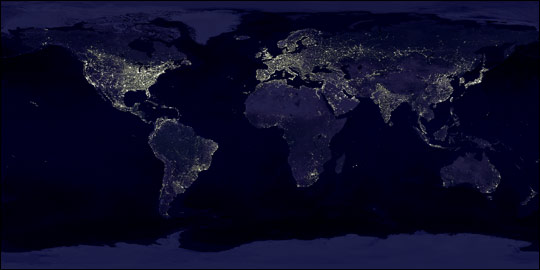
This fascinating image was assembled using data from a number of satelittes orbiting the Earth.

It really highlights where the main centres of population can be found; the eastern half of North America, Europe, India, Japan, eastern China.

On the high-resolution image found at the Visible Earth website you can see individual countries in greater detail.

Saturday, April 01, 2006

Solar eclipse


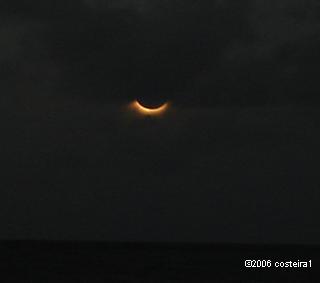
Photograph: ©2006 costeira1

Last week's solar eclipse somewhat escaped me. I'd heard that channel 5 was going to be broadcasting live pictures in the morning. I made a mental note to watch, but it was a dull day here and the middle of the afternoon before I remembered.

This photograph by Alexandre Amorim is of the eclipse as seen on Ponta Negra's Beach, Natal, Brazil, at 08:35 UT, using a 7x50 binoculars and digital camera Sony S40, ISO80, f/5.1, 1-sec exposure.

Many photos can be seen on the Solar Eclipse Gallery, some by amateurs and some by serious astronomers. One of my favourites though is the one by Joe on the Rome Daily Photoblog.

Some friends of mine have gone on holiday to Turkey especially to witness the eclipse, but they haven't returned yet!